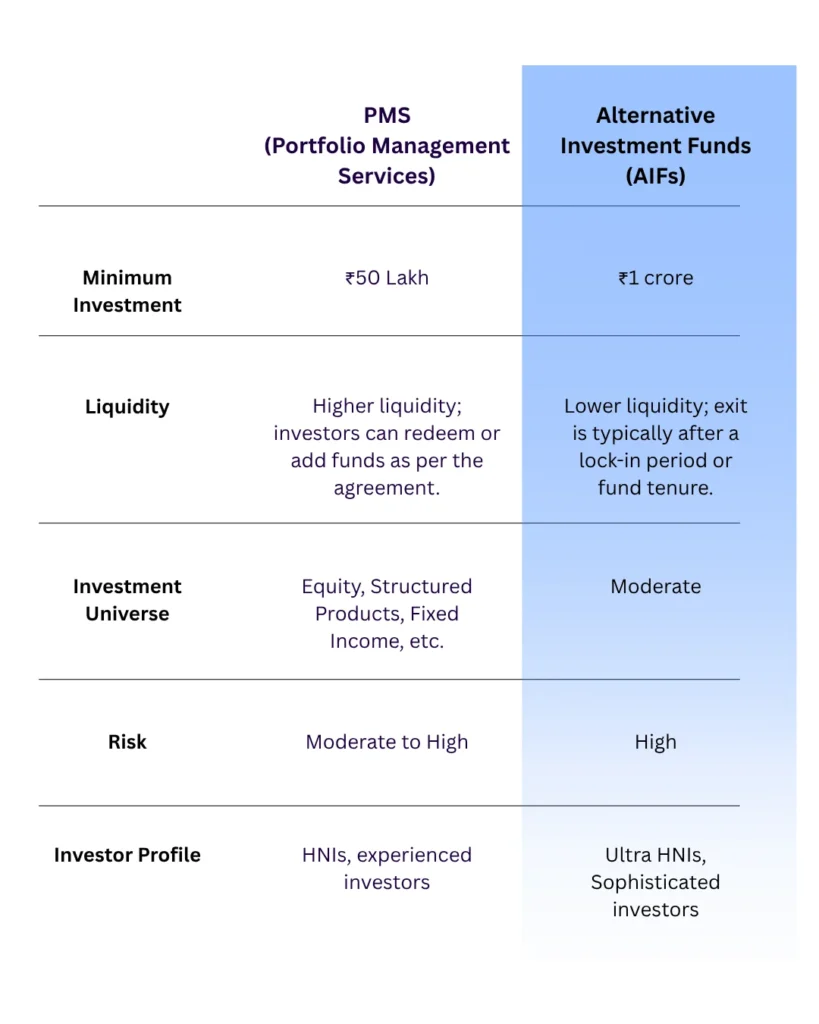
Imagine you have ₹1 crore to invest. Your wealth advisor tells you: “Put it in a mutual fund for safe, diversified growth.” “Try a PMS for a customized strategy.” “Or,...
Read More


Alternative Investment Funds (AIFs) are privately pooled investment vehicles that collect money from investors and invest it according to a defined strategy. Unlike traditional options like mutual funds or fixed deposits, AIFs focus on alternative assets such as private equity, venture capital, hedge funds, real estate, or even debt instruments.
They are ideal for high-net-worth investors who want to diversify beyond the stock market and seek higher, risk-adjusted returns through professionally managed portfolios.
As per SEBI regulations, the minimum investment amount is ₹1 crore, while for employees or directors of the fund, it is ₹25 lakh.
Alternative Investment Funds (AIFs) pool money from high-net-worth investors and institutions to invest in unique, high-growth opportunities such as startups, private equity, real estate, or debt instruments, depending on the fund’s strategy.
Once investors commit a minimum of ₹1 crore, the fund manager professionally manages and deploys this capital as per the fund’s defined mandate. These funds are typically closed-ended, meaning investors stay invested for a fixed tenure, and redemptions happen at maturity or during specific exit opportunities.
Returns are distributed to investors based on the performance of the underlying assets, after deducting management and performance fees. Regular disclosures and compliance are ensured under SEBI’s AIF Regulations, providing a transparent and regulated investment structure.
Access to Exclusive Opportunities
Invest in unlisted companies, startups, real estate, and private equity deals that are usually unavailable through mutual funds or PMS.
Professional Fund Management
Your capital is managed by experienced fund managers who use research-backed strategies to identify high-growth opportunities.
Potential for Superior Returns
With a long-term and flexible investment approach, AIFs aim to deliver superior returns compared to conventional options.
Regulated and Transparent
All AIFs are registered and monitored by SEBI under the Alternative Investment Funds Regulations, 2012, ensuring transparency, disclosures, and investor protection.
Diversified Portfolio
By including non-traditional assets, AIFs help reduce overall risk and enhance your portfolio’s resilience across market cycles.
AIFs in India are classified into three categories based on their investment objectives and risk-return profile:
These funds focus on investments that promote entrepreneurship, innovation, and economic development. They primarily channel capital into early-stage businesses, startups, and sectors that generate employment or have a positive social impact.
Types of Category I AIFs:
– Venture Capital Funds (VCFs) – Invest in early-stage startups and businesses with high growth potential.
– SME Funds – Provide capital to Small and Medium Enterprises (SMEs) for expansion and modernization.
– Social Venture Funds – Invest in companies addressing social or environmental challenges, such as clean energy, healthcare, or education.
– Infrastructure Funds – Finance large-scale infrastructure projects like roads, airports, ports, and smart cities.
Focused on long-term wealth creation through private equity or debt instruments. These funds follow moderate-risk strategies with limited leverage.
Types of Category II AIFs:
– Private Equity Funds (PEFs) – Invest in unlisted or privately held companies to fund growth, acquisitions, or restructuring.
– Debt Funds – Provide credit to companies through structured debt instruments, offering higher returns compared to traditional fixed-income investments.
– Fund of Funds (FoFs) – Invest in a portfolio of other AIFs
Designed for high-net-worth investors seeking aggressive growth. These funds use advanced strategies like long-short, arbitrage, and derivatives trading to generate returns.
Types of Category III AIFs:
– Hedge Funds – These funds use smart trading techniques like buying and shorting stocks, using derivatives, and spotting price gaps to earn higher returns.
– PIPE Funds (Private Investment in Public Equity) – Invest in listed companies through private placements, usually at discounted prices, to support expansion or turnaround plans.
Imagine you have ₹1 crore to invest. Your wealth advisor tells you: “Put it in a mutual fund for safe, diversified growth.” “Try a PMS for a customized strategy.” “Or,...
Read MoreSIP or Systematic Investment plans have caught up as a household name. Most people today choose a digital platform of choice and invest in monthly SIPs. While there is nothing...
Read MoreAchieving financial independence has become a necessity, and investing strategically has become a fundamental part of modern life. According to the NSDL and CDSL data, 2024 saw a 33% increase...
Read MoreMarkets move, so do we.
Bringing you the fastest dose of financial news, market updates, and one-of-a-kind tools, so you have the first mover advantage, the Ashvvy Advantage.
3000+ people are growing their wealth with us, are you next?
ABOUT US
HELP
AMFI Registered Mutual Fund Distributor | ARN- 172057 | Initial Date of Registration: 28/8/2020 | Current Validity: 27/8/2026
Grievance Officer: Rishika Jain | 9643879317
Copyright © 2025 Ashvvy Investment. All rights reserved.