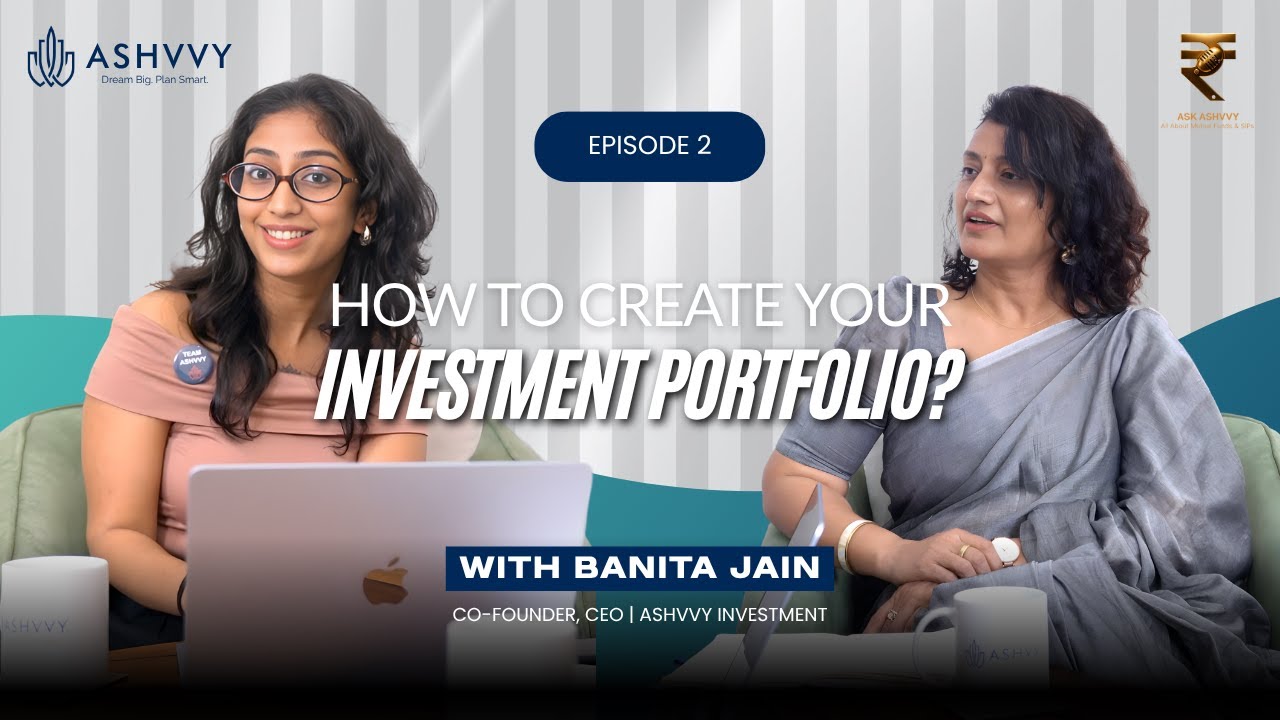
AskAshvvy Ep2 | How to create your Portfolio ft. Banita Jain

Ask Ashvvy

Author

Date

Share Now

AskAshvvy Ep2 | How to create your Portfolio ft. Banita Jain

Equity vs. Debt Allocation

  • The Age Rule: A common thumb rule is to keep a percentage of debt in your portfolio equal to your age. Younger investors can take more risks because they have fewer liabilities [00:47].

  • Life Stages: As you reach ages 40-45, liabilities like children’s education and approaching retirement increase, necessitating a higher shift toward debt for stability [01:05].

  • Market Volatility: Regardless of age, keeping some debt helps manage market fluctuations [01:30].

Selecting Mutual Funds

  • Avoid Chasing Past Performance: Investors often mistakenly pick “top-performing funds.” However, rankings change every financial year, and a top fund today might drop in rank tomorrow [02:05].

  • Goal-Based Selection: categorize your investments by time horizon:

    • Short-term (0-6 months): Use overnight or low-duration funds for liquidity [02:52].

    • Medium-term (up to 4 years): Target goals like buying a car or travel [03:03].

    • Long-term: Focus on retirement or children’s education using small-cap or sectoral funds [03:19].

Portfolio Diversification (The "Thali" Analogy)

  • Stable Funds (The Main Meal): Large-cap and index funds are like “dal and chapati”—essential daily staples for stability [04:40].

  • High-Risk Funds (The Dessert): Sectoral or thematic funds (like IT or Pharma) are like “sweets”—they should only make up a small portion (about 5%) of your portfolio [05:32].

Investment Strategy (SIPs)

  • Monthly Savings: Aim to invest 25% to 30% of your income [03:28].

  • Inflation Planning: When planning for the future (like retirement), look at current household expenses and adjust for inflation based on historical trends (e.g., gold prices or household costs from 10 years ago) [07:04].

  • Avoiding Concentration: Don’t put all your money into one bucket, such as just small-cap funds, just because they showed high returns recently [08:06].

Liquidity and Redemptions

  • Lock-in Periods: Most funds are “open-ended,” but Tax Saving (ELSS) funds have a 3-year lock-in, and some retirement/children’s funds have a 5-year lock-in [09:06].

  • Withdrawal Time: Once you apply for redemption, funds typically reach your bank account within 2 to 3 working days [09:40].

For more details, you can watch the video here

“It’s not how much money you make, but how much money you keep, how hard it works for you, and how many generations you keep it for.”

Robert Kiyosaki

Wealth Manager

Tags :

Investment,Mutual Fund,Portfolio
Picture of Ashwin Jain

Ashwin Jain

Ashwin Jain is a Certified Financial Planner (CFP) with over 4 years of experience in content writing. She blends financial expertise with storytelling to craft insightful and actionable blogs. Ashwin has previously worked with leading finance brands like AngelOne, ICICI Direct, Alice Blue, and Bima Kavach.

Related Articles

Leave a Reply

Your email address will not be published. Required fields are marked *

Plan Your Wealth

Talk to an Ashvvy expert and create your personalized investment roadmap today.

The Ultimate Wealth
Journal 2025

Dhan Tatva Mag

Clarify All Your Doubts. Get Free Consultation

Download Dhan Tatva Now

Dhan Tatva
Dhan Tatva