April 2026 comes at a time when markets are a bit uncertain due to global factors like the Middle East situation and changing economic conditions. In such phases, investors usually focus more on balancing risk and diversification.
At the same time, mutual fund houses are launching new schemes across equity, hybrid, ETF, and arbitrage categories. These NFOs offer different ways to invest, whether you are looking for growth, stability, or better diversification.
If you’re planning to explore new options, understanding what each fund offers can help you make a better decision. Below is a simple snapshot of some key mutual fund NFOs to track in April 2026.
Key Upcoming NFOs in April 2026
Before looking at specific NFOs, it’s important to understand how NFOs work and how to evaluate them. Check this out –
What is an NFO in Mutual Funds? A Simple Guide for Beginners
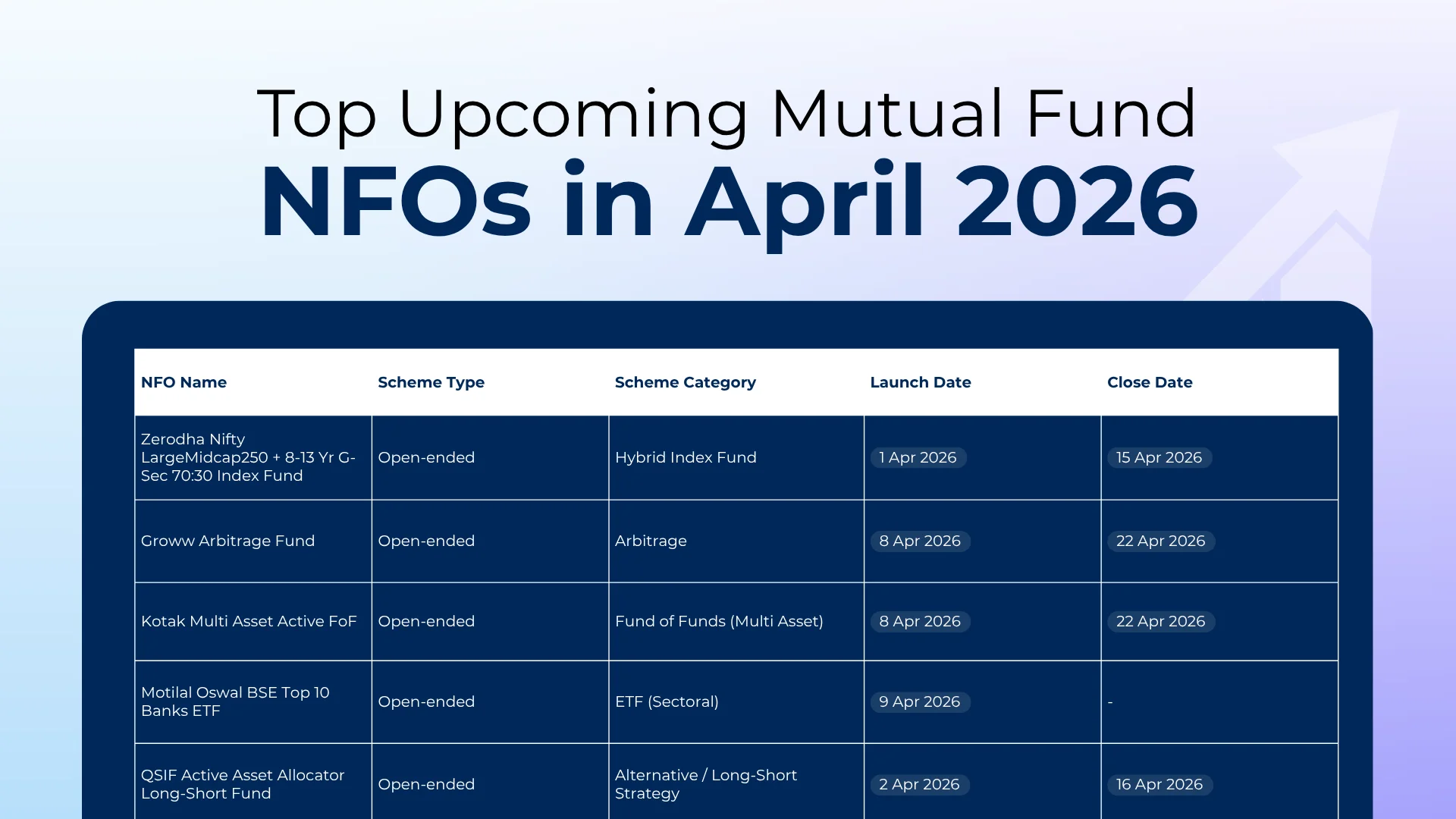
NFO Fund Name | Scheme Type | Scheme Category | Launch Date | Close Date |
Zerodha Nifty LargeMidcap250 + 8-13 Yr G-Sec 70:30 Index Fund | Open-ended | Hybrid Index Fund | 01 Apr 2026 | 15 Apr 2026 |
Groww Arbitrage Fund | Open-ended | Arbitrage | 08 Apr 2026 | 22 Apr 2026 |
Kotak Multi Asset Active FoF | Open-ended | Fund of Funds (Multi Asset) | 08 Apr 2026 | 22 Apr 2026 |
Motilal Oswal BSE Top 10 Banks ETF | Open-ended | ETF (Sectoral) | 09 Apr 2026 | – |
QSIF Active Asset Allocator Long-Short Fund | Open-ended | Alternative / Long-Short Strategy | 02 Apr 2026 | 16 Apr 2026 |
1. Zerodha Nifty LargeMidcap250 + 8–13 Yr G-Sec 70:30 Index Fund
This is a hybrid index fund that combines equity and debt in a fixed ratio. Around 70% of the portfolio is invested in the Nifty LargeMidcap 250 Index, while the remaining 30% is allocated to long-term government securities.
The idea is to balance growth from equities with stability from debt. Since it follows an index-based approach, the fund aims to replicate the performance of its benchmark rather than actively picking stocks.
Suitable for: Investors looking for a mix of equity growth and debt stability in a single fund.
2. Groww Arbitrage Fund
This fund uses an arbitrage strategy, where it tries to capture price differences between the cash and derivatives markets. The goal is to generate relatively steady returns without taking major directional bets on the market.
A portion of the portfolio may also be invested in debt & money market instruments for liquidity and stability.
Suitable for: Investors looking for low-risk, short-term allocation with relatively stable returns.
3. Kotak Multi Asset Active FoF
This fund invests across multiple asset classes (equity, debt, and commodities) through underlying mutual funds. Instead of depending on one type of investment, it spreads money across different segments.
This helps reduce overall portfolio risk and simplifies diversification, as investors get exposure to multiple assets through a single fund.
Suitable for: Investors who want diversification across asset classes without managing multiple investments.
4. Motilal Oswal BSE Top 10 Banks ETF
This ETF tracks the BSE Top 10 Banks Index and invests in leading banking stocks. It provides focused exposure to the banking sector, which plays an important role in the economy.
Since it is a passive fund, it simply mirrors the index and does not actively select stocks.
Suitable for: Investors who want targeted exposure to the banking sector through a low-cost passive route.
5. QSIF Active Asset Allocator Long-Short Fund
This fund follows a long-short strategy, where it takes both long (buy) and short (sell) positions in the market. The aim is to generate returns across different market conditions by actively managing exposure. Such strategies focus on reducing downside risk while capturing available opportunities.
It actively adjusts exposure based on market conditions and may also allocate across different asset classes. Such strategies are more flexible but can also be more complex compared to traditional mutual funds.
Suitable for: Investors who understand advanced strategies and are looking for more flexible, actively managed exposure during volatile markets. The minimum NFO investment is ₹10,00,000, with SIP available at a minimum of ₹10,000 per instalment (at least six instalments required).
Final Thoughts
April 2026 NFOs offer a mix of different investment options, from equity and hybrid funds to arbitrage and more flexible strategies. Each fund serves a different purpose, so it’s important to focus on what fits your needs rather than just investing because it’s new.
Before investing, take a moment to understand the fund’s approach, risk level, and how it adds to your existing portfolio.
At Ashvvy Investments, we help you understand these options better and guide you in choosing what works for your long-term financial goals.