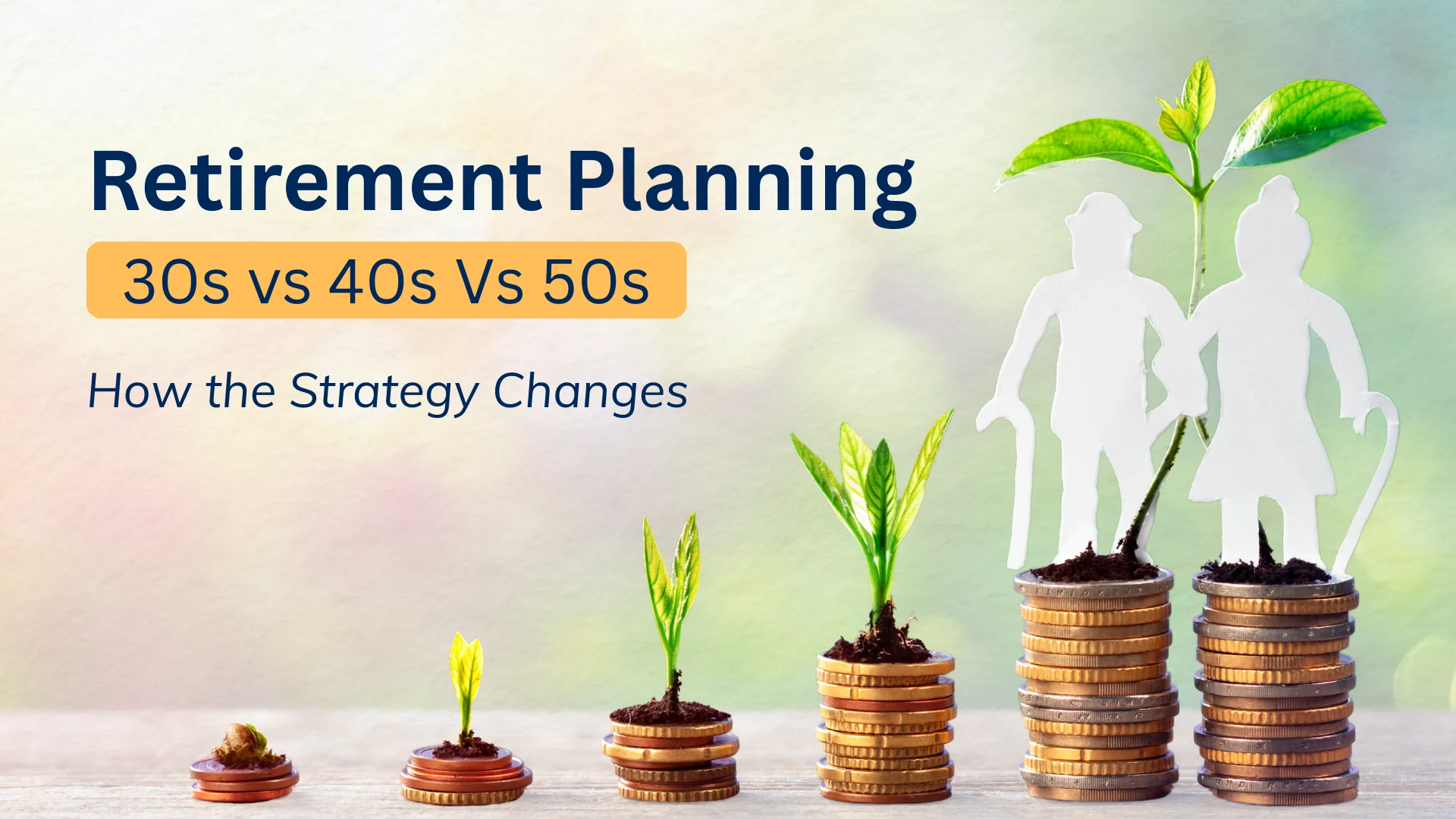
Retirement planning is often misunderstood as a senior-citizen topic. In reality, it’s a time-and-discipline game, because the earlier you start, the easier it becomes. Even if you start late, retirement isn’t out of reach. You just need a different strategy depending on your starting point.
In this blog, you’ll understand how retirement planning at 30, 40, and 50 differs, what you need to do at each stage, and realistic numbers to help you plan better.
Why Retirement Planning Matters More Today
– Longer life spans: A person retiring at 60 today might live till 85-90, meaning 25-30 years of post-retirement expenses.
– Minimal pension coverage: Formal pension systems are weak in India, with pension assets at just about 3% of GDP, far below countries like Australia (130%). Around 88% of Indian workers have no formal retirement coverage at all.
– Family Support Is Shrinking: Joint families are declining, and over 70% of Indians aged 60+ depend on family for financial support, indicating low self-sufficiency.
– Increasing Inflation: Your expenses won’t remain the same during retirement. For example, a ₹1 lakh/month lifestyle today could cost ₹4-5 lakh/month in 25-30 years assuming 6-7% inflation. Health, education, housing, and medical care rise even faster than basic inflation.
Retirement Planning at 30
At 30, you have nearly 25-30 years till retirement and this is a ideal time to plan. This allows smaller monthly investments to grow significantly due to compounding.
Ideal Strategy in Your 30s
1. Build a core retirement fund through equity funds or ETFs:
In your 30s, time is your biggest edge. Equity mutual funds and index ETFs (Nifty/Sensex) are great long-term instruments that can beat inflation.
2. Use SIPs with step-ups:
Start with an affordable SIP amount and increase it by 5–10% every year as your income grows. For instance, starting with ₹10,000 per month and stepping up 10% annually can make a huge difference in final corpus.
3. Maintain financial safety nets:
Before chasing returns, secure your base:
- Emergency fund for 9-12 months of expenses
- Term insurance for family protection
- Health insurance to avoid dipping into investments
4. Aim for 70-80% equity exposure:
Since you have time on your side, your portfolio can afford volatility. Equities offer growth, while 10-20% debt provides stability. Review allocation annually and rebalance if needed.
Retirement Planning at 40
At 40, time is reduced to 15-20 years. Responsibilities tend to pile up, like home loans, children’s schooling, aging parents, etc. So,investing may feel harder, but it’s still very achievable with the right approach.
Ideal Strategy in Your 40s
1. Increase contribution rate:
Since time is shorter, try allocating 25–35% of your income towards investments. If increasing monthly amount is difficult, step-up SIPs become useful here as well.
2. Balance growth and safety through hybrid allocation:
A mix of equity and debt can reduce volatility. A typical allocation could be:
- 60% Equity
- 30% Hybrid or Balanced Advantage Funds
- 10% Debt (PPF, EPF, Debt Funds)
3. Avoid mixing goals:
One of the biggest mistakes at 40 is mixing kids’ education and retirement funding. Keep separate goals and separate investments.
4. Optimize tax-advantaged products:
Use instruments like NPS, PPF, EPF, ELSS for both tax benefits and retirement growth.
Retirement Planning at 50
At 50, there are only about 10-15 years left for accumulation. Here the priority shifts from wealth growth to wealth preservation and income planning.
Ideal Strategy in Your 50s
1. Increase savings rate aggressively:
Since time is tight, increasing your savings rate becomes essential. Aiming for 35-45% of your income, and routing bonuses, or unexpected gains into retirement, can make a meaningful difference.
2. Reduce equity exposure gradually:
Volatility can hurt you more at this stage because you don’t have decades to recover. A typical allocation may look like:
- 10-20% Equity
- 30% Hybrid
- 50-60% Debt (FDs, SCSS, POMIS, Debt Funds)
3. Focus on debt and income instruments:
Consider products like: SCSS (Senior Citizens Saving Scheme), debt mutual funds, Post Office Monthly Income Scheme, etc. These products offer stability and predictable income.
4. Clear major liabilities:
Entering retirement with home loans or large EMIs can strain your pension years. Try to close major loans before age 60.
5. Upgrade health cover:
As health risks rise with age, strengthen your health cover and explore critical illness plans. This keeps medical costs from eating into your retirement corpus.
How Retirement Strategy Evolves Over Time
The way you plan for retirement at 30 will never be the same as at 40 or 50. Early on, you have time to grow your money. In your mid-career years, expenses rise and stability matters. Closer to retirement, protecting your capital becomes the priority. Since your lifestyle and needs evolve, your retirement number evolves too. Using a retirement calculator helps you understand what your future might cost and how to prepare for it.
Age | Risk Level | Equity Allocation | Monthly Requirement | Key Focus |
30 | High | 70-80% | Low | Compounding & Growth |
40 | Moderate | 50-60% | Moderate | Balance & Discipline |
50 | Low | 10-20% | High | Preservation & Income Stability |
Final Thoughts
Retirement planning is all about being consistent. Whether you’re 30, 40, or 50, the most important decision is to start today.
Planning your retirement can feel overwhelming if you’re doing it alone. If you want a structured plan, tax-efficient allocation, or clarity on how much to invest every month, you can consult Ashvvy Investments for personalized retirement planning and get a clear roadmap tailored to your situation.