The end of the year is here, and mutual fund houses are launching a fresh batch of new schemes. December 2025 brings a mix of equity, hybrid, and passive funds that promise new opportunities for investors looking to diversify their portfolios or explore fresh themes.
If you’re on the lookout for the best mutual fund to invest in 2025, knowing what’s coming up this month can help you make informed choices. Let’s take a closer look at the key NFOs in December 2025, what they aim to do, and which investors they might suit best.
Key Upcoming NFOs in December 2025
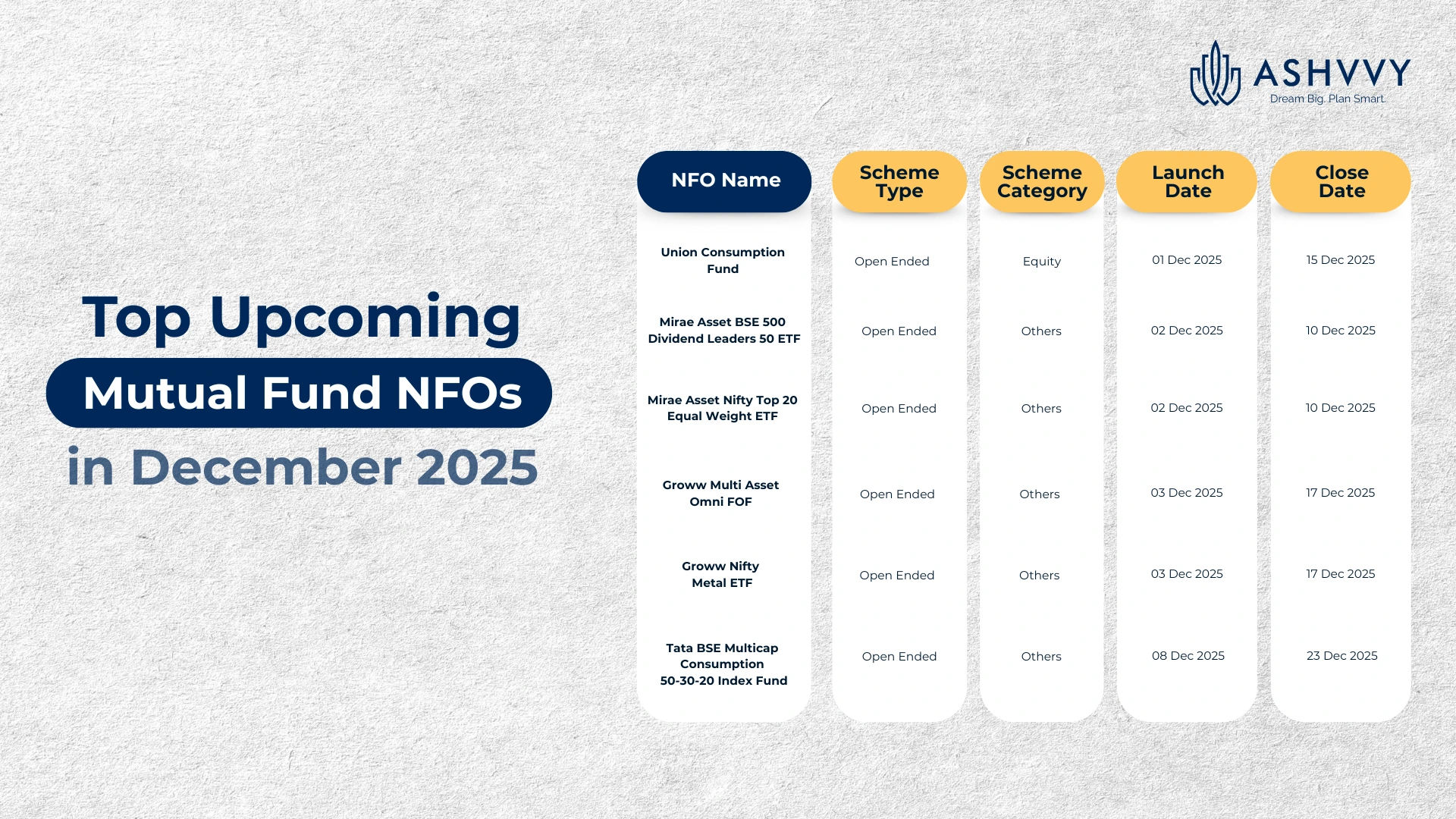
Here are some of the notable NFOs launching this month:
NFO Name | Scheme Type | Scheme Category | Launch Date | Close Date |
Union Consumption Fund | Open Ended | Equity | 01 Dec 2025 | 15 Dec 2025 |
Mirae Asset BSE 500 Dividend Leaders 50 ETF | Open Ended | Others | 02 Dec 2025 | 10 Dec 2025 |
Mirae Asset Nifty Top 20 Equal Weight ETF | Open Ended | Others | 02 Dec 2025 | 10 Dec 2025 |
Groww Multi Asset Omni FOF | Open Ended | Others | 03 Dec 2025 | 17 Dec 2025 |
Groww Nifty Metal ETF | Open Ended | Others | 03 Dec 2025 | 17 Dec 2025 |
Tata BSE Multicap Consumption 50-30-20 Index Fund | Open Ended | Others | 08 Dec 2025 | 23 Dec 2025 |
1. Union Consumption Fund
This equity fund invests in companies benefiting from India’s expanding consumer base, rising incomes, and urban lifestyle shifts. It provides a way for investors to participate in domestic demand trends across retail, FMCG, and similar sectors. Ideal for those seeking thematic exposure with a long-term growth perspective.
2. Mirae Asset BSE 500 Dividend Leaders 50 ETF
This passive ETF tracks the BSE 500 Dividend Leaders 50 Index, focusing on high-dividend-yielding companies from the BSE 500 universe. It invests in companies with a consistent history of paying dividends, offering investors a mix of potential capital growth and steady income. Being an ETF, it provides low-cost, diversified exposure to high-quality dividend-paying stocks.
3. Mirae Asset Nifty Top 20 Equal Weight ETF
The Mirae Asset Nifty Top 20 Equal Weight ETF lets you invest in India’s 20 largest companies, which together represent nearly half of the nation’s market capitalization. With each stock given equal weight, your investment spreads evenly across sectors like Financials, IT, Consumer Goods, Automobiles, and Telecom. Large-cap companies are generally more stable and financially strong, helping your portfolio weather market fluctuations.
4. Groww Multi Asset Omni FOF
The Groww Multi Asset Omni FoF spreads your investment across equity, debt, and gold and silver ETFs to create a balanced portfolio. By combining financial assets with commodities, the fund aims to reduce market volatility and support steady wealth creation. It’s designed for investors who want diversification and stability, but with the ease of a single fund.
5. Groww Nifty Metal ETF
The Groww Nifty Metal ETF invests in India’s leading metal and mining companies by tracking the Nifty Metal Index. With strong demand expected from infrastructure development, renewable energy, and EV manufacturing, the metal sector is well-positioned for long-term growth. This ETF offers a low-cost and diversified route to participate in that trend.
6. Tata BSE Multicap Consumption 50-30-20 Index Fund
The Tata BSE Multicap Consumption 50-30-20 Index Fund provides diversified exposure to India’s consumption-focused companies across large, mid, and small caps. Its goal is to mirror the BSE Multicap Consumption 50:30:20 Index with minimal tracking error. With consumption emerging as one of India’s strongest long-term growth drivers, this fund enables investors to tap into the theme efficiently and at a low cost.
Final Thoughts
December 2025 brings a mix of NFOs, from thematic equity and multi-asset funds to passive ETFs. Picking the best mutual fund to invest in 2025 depends on your risk profile, investment horizon, and financial goals. While NFOs offer new opportunities, it’s important to assess each fund’s theme, costs, and fit. At Ashvvy Investments, we guide you in analyzing upcoming NFOs, aligning them with your objectives, and choosing the right allocation for your portfolio.